

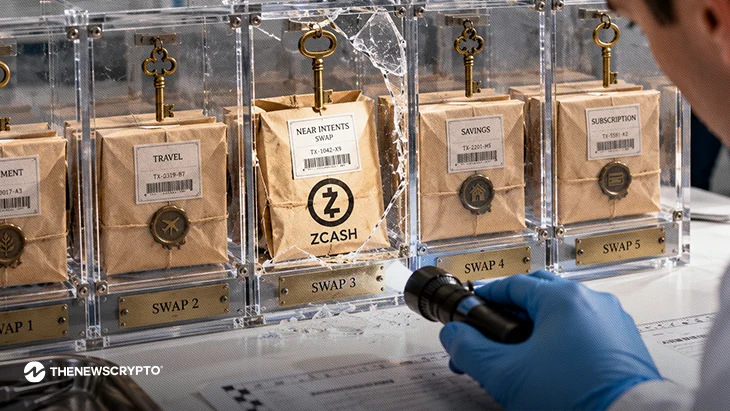
- Zakura has introduced a plan for distinct viewing keys during ZEC swaps via NEAR Intents to mitigate potential risks from future quantum attacks.
- This measure is designed to stop compromised viewing keys from revealing an entire Zcash payment history, which includes private memos and amounts.
- By leveraging private information retrieval (PIR), Zakura enables wallets to track down refunds without disclosing the checked addresses to the database operators.
Zcash infrastructure builder Zakura has introduced a novel wallet feature intended to safeguard user transaction privacy against hypothetical upcoming quantum computing threats. Under this scheme, every Zcash (ZEC) swap executed via NEAR Intents would be assigned a unique incoming viewing key. Consequently, this confines the scope of payment history an attacker could compromise should the cryptography tied to a publicly exposed address eventually be broken.
Adam Tucker, a Zakura developer, detailed the proposal on October 18, focusing on a vulnerability inherent to cross-chain swaps. Because NEAR Intents publishes Zcash addresses directly onto its public blockchain, unused funds can be successfully returned if a transaction fails or does not utilize the full deposit. These addresses stay visible on-chain regardless of whether a refund is ultimately needed.
Although Zcash shielded transactions effectively conceal transaction specifics, addresses belonging to the same wallet generally share a single incoming viewing key. A quantum computer possessing sufficient power and running Shor’s algorithm could theoretically extract this key from a public address, potentially exposing the memos and amounts of payments received by that account. Presently, no quantum computer capable of executing such an exploit exists.
Separate Keys Aim to Limit Potential Exposure
Zakura’s solution suggests utilizing an independent incoming viewing key for each individual swap, while leaving the wallet’s main spending key completely untouched. Should an attacker in the future manage to recover the viewing key connected to a single publicly visible address, the resulting data leak would restrict itself strictly to payments associated with that specific address, leaving the broader transaction history safe.
The framework also resolves the logistical difficulty of recovering wallets that manage numerous distinct keys. To overcome this, Zakura advocates for private information retrieval (PIR), a cryptographic method that empowers a wallet to search database records for relevant transactions without disclosing the queried addresses to the database operators.
Implementing this update does not necessitate a Zcash network upgrade. According to Zakura, software wallets developed using its open-source libraries—such as Vizor—could adopt this functionality within the next few weeks. Support for hardware wallets is anticipated at a later date once the requisite firmware becomes available.
This initiative coincides with ongoing efforts by Zcash developers to build comprehensive quantum-resistant payment safeguards, including the upcoming Tachyon upgrade. Even so, Zakura’s concept operates strictly as a wallet-level mitigation strategy rather than a network-wide protocol fix already rolled out to the general user base.
Ultimately, the immediate objective is to minimize the volume of private transaction data that could be compromised during a theoretical future quantum assault, all while enabling users to continue spending assets through their standard wallet accounts.
Frequently Asked Questions
What problem does Zakura’s proposal address?
The proposal tackles a specific cross-chain swap vulnerability where Zcash addresses are published on the public NEAR Intents blockchain to facilitate refunds. If a future quantum computer breaks the cryptography on a public address, it could theoretically expose a shared incoming viewing key and compromise the user’s private payment history.
How do separate viewing keys protect Zcash privacy?
By assigning a unique incoming viewing key to each individual swap—while keeping the main spending key unchanged—an attacker who compromises one address can only view transactions tied directly to that address, rather than the entire wallet history.
Does this feature require a Zcash network upgrade?
No, this is a wallet-level safeguard rather than a network-wide change. Software wallets built with Zakura’s open-source libraries, like Vizor, can integrate the feature independently, with hardware-wallet support planned for the future.
What is private information retrieval (PIR) used for in this proposal?
PIR is used to solve the practical challenge of wallet restoration. It allows a wallet to locate relevant refund transactions in a database without revealing to the database operator which specific addresses are being checked.
