

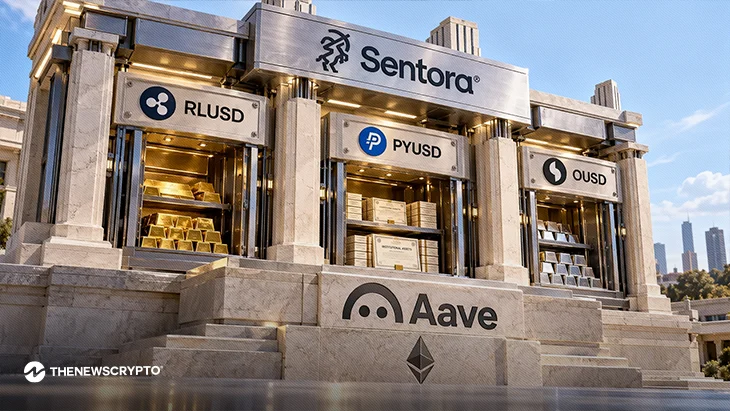
- Aave V4 has rolled out its inaugural externally curated lending markets on Ethereum, with risk parameters overseen by Sentora.
- These three fresh markets enable users to take out loans in RLUSD, PYUSD, and OUSD using designated crypto assets as collateral.
Decentralized lending protocol Aave has introduced its premier externally curated markets on Aave V4, empowering risk management firm Sentora to direct specialized markets. Unveiled on October 22, the rollout establishes three Ethereum-based markets where participants can borrow specific stablecoins against approved crypto holdings.
The trio of markets consists of RLUSD Yield, OUSD Yield, and Bluechip. The RLUSD Yield market lets individuals borrow Ripple’s RLUSD using USDe, PRIME, mWIN, and PST as collateral. Similarly, OUSD Yield permits borrowing via Origin Protocol’s OUSD against those exact same collateral assets. Meanwhile, the Bluechip market enables users to secure loans in RLUSD, PayPal’s PYUSD, or OUSD by utilizing kBTC, which is a Bitcoin-backed token.
The first externally curated markets on Aave V4 are now live, with strategy by @SentoraHQ.
Users can borrow RLUSD, PYUSD, and OUSD against yield-bearing and blue-chip collateral across three new markets on @ethereum. https://t.co/zFD052SO19— Aave (@aave) October 22, 2026
This milestone represents Aave V4’s maiden deployment of external market curation. Instead of depending entirely on a single protocol-wide set of guidelines, an independent risk manager now establishes bespoke lending conditions for these particular markets.
Sentora Takes on Market Risk Management
Through this partnership, Sentora oversees oracle pricing, interest-rate models, collateral selection, and liquidation rules for the new arenas. These choices dictate which deposits are permitted, borrowing limits, and the exact conditions under which undercollateralized positions face liquidation.
Aave V4 operates on a Hub-and-Spoke architecture. The central Hub maintains liquidity, whereas individual Spokes outline the regulations for separate lending pools. This setup enables specialized markets to function under the broader protocol umbrella without automatically sharing uniform risk controls.
Built-in governance safeguards also govern these external markets. Any adjustments that increase risk are subject to a 48-hour timelock, whereas changes that decrease risk may take effect right away. Furthermore, integrating fresh collateral types or deploying new Hubs requires a mandatory two-week governance review period. The Aave DAO keeps full ownership of the underlying smart contracts and retains the authority to strip Sentora of its operational privileges through governance votes.
Per the governance proposal, any profits generated from this partnership will be divided evenly between the Aave DAO and Sentora.
The initial disclosure from Aave omitted figures concerning user counts, revenue, borrowing volumes, and starting deposits for the trio of markets. Although a fourth market dubbed PYUSD Yield was floated as a prospective future addition during the proposal stage, it was absent from the initial lineup of three live markets.
Ultimately, the rollout provides Aave V4 with a mechanism to facilitate targeted lending strategies while compartmentalizing risk controls for each individual market. Its ultimate financial footprint and broader adoption rates will emerge as participants begin supplying assets and borrowing within the fresh pools.
Frequently Asked Questions
What are the first externally curated markets on Aave V4?
The first three externally curated markets are RLUSD Yield, OUSD Yield, and Bluechip, operating on the Ethereum network.
Who manages the risk parameters for these new markets?
Risk management firm Sentora oversees collateral selection, interest-rate models, price oracles, and liquidation settings for these specialized markets.
How is revenue split between Aave and Sentora?
According to the governance proposal, any revenue generated through the arrangement is divided equally 50-50 between the Aave DAO and Sentora.
Can the Aave DAO revoke Sentora’s permissions?
Yes, the Aave DAO retains ownership of the underlying contracts and holds the governance power to revoke Sentora’s operational permissions at any time.
