


- TSV LLC, OKXICE, and Perpetuals.com have been named by the SEC as the first three businesses to file notices of intent to run tokenized securities venues via its Innovation Exemption.
- While this exemption mandates a minimum of 30 days of public notice alongside safeguarded investor protections, simply filing the notice does not grant the company regulatory approval to launch.
The U.S. Securities and Exchange Commission (SEC) has published a list of three enterprises hoping to roll out blockchain-powered trading venues for tokenized U.S. equities under its recently introduced Innovation Exemption.
As reflected in the SEC’s official roster updated on October 21, the participating firms are TSV LLC, OKXICE, and Perpetuals.com. TSV LLC filed its notice of intent on September 23, OKXICE followed on October 4, and Kephas Corporation—operating as Perpetuals.com—submitted its paperwork on October 14.
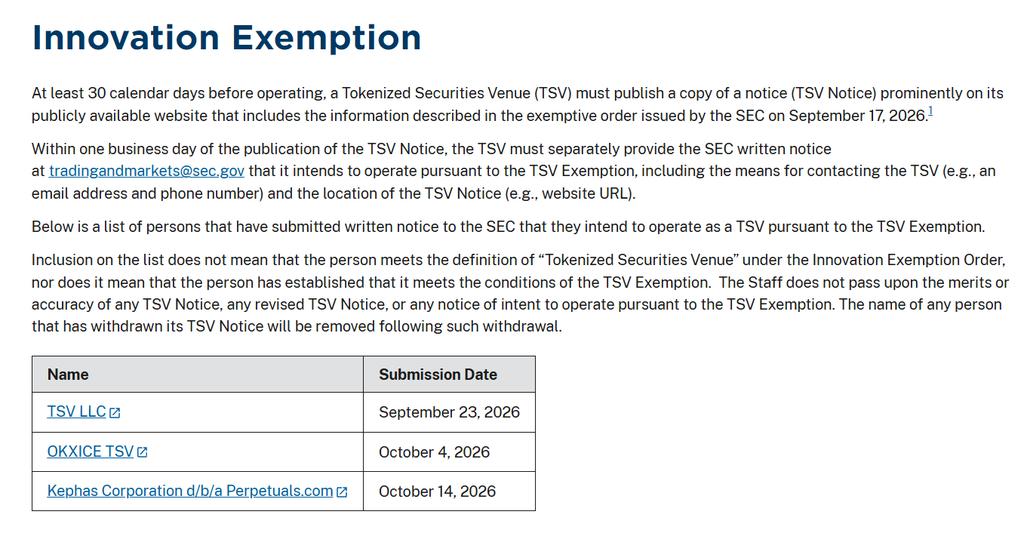
These submissions follow the SEC’s September 17 launch of the Innovation Exemption, which provides eligible tokenized securities venues with temporary and conditional relief from standard federal securities laws defining an exchange. This framework allows specific blockchain trading platforms to function under defined parameters while the agency collects public feedback.
Nevertheless, inclusion on the SEC roster does not equate to regulatory approval to launch. The agency has clarified that filing a notice does not verify that a business satisfies all criteria of the exemption.
SEC Sets Conditions for Tokenized Stock Trading
The regulatory relief applies to certain tokenized National Market System stocks, encompassing shares traded on national U.S. exchanges. Participating venues are permitted to utilize blockchain setups such as liquidity pools and automated market makers, provided they comply with the order’s stipulations.
Every venue is required to host its operating notice on an accessible public website at least 30 calendar days prior to launching operations. Furthermore, the venue must inform the SEC within a single business day following the publication of that notice.
Investor safeguards are built directly into the structure. Tokenized shares are mandated to retain all rights and privileges tied to traditional equities. Additionally, issuers whose securities are tokenized by third parties retain the right to block their shares from being traded on a venue operating under this exemption.
OKXICE—a partnership between crypto exchange OKX and Intercontinental Exchange, which owns the New York Stock Exchange—has indicated that its proposed platform will utilize the X Layer network from OKX. Their initial notice identified over 60 U.S.-listed corporations for prospective tokenization.
Although TSV LLC and Perpetuals.com have likewise filed their notices, their presence on the SEC register is not an affirmation that their respective platforms are active.
Set to expire five years after publication in the Federal Register unless modified or prolonged by the regulator, the Innovation Exemption is temporary and conditional. These three initial filings represent a preliminary stride toward integrating blockchain infrastructure into U.S. stock trading.
Frequently Asked Questions
What is the SEC’s Innovation Exemption?
Introduced on September 17, the Innovation Exemption grants qualifying tokenized securities venues temporary, conditional relief from the standard definition of an exchange under federal securities law, allowing blockchain-based trading systems to operate under specific rules while the SEC gathers feedback.
Which firms are the first to file notices under the exemption?
The initial three companies listed by the SEC are TSV LLC, OKXICE, and Perpetuals.com (operated by Kephas Corporation).
Does filing a notice mean these platforms are approved to launch?
No. Appearing on the SEC list does not signify that the companies have received authorization to launch, nor does it confirm that they meet all of the exemption’s official requirements.
How long does the Innovation Exemption last?
The exemption is temporary and conditional, scheduled to expire five years following its publication in the Federal Register unless the agency decides to change or extend the regulatory framework.
