

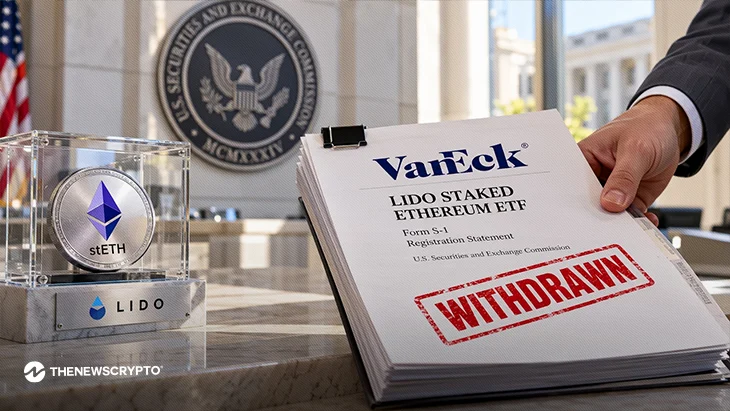
- VanEck requested withdrawal of its proposed Lido Staked Ethereum ETF.
- The fund was designed to track stETH’s price performance after expenses.
- The SEC had not declared the registration effective, and no shares were issued or sold.
VanEck has asked the U.S. Securities and Exchange Commission (SEC) to cancel its registration for the proposed VanEck Lido Staked Ethereum ETF, scrapping plans for a fund that would have provided investors with exposure to the Ethereum liquid-staking market via a traditional exchange-traded product.
According to a Form RW filing submitted on October 14, 2026, VanEck Digital Assets stated that it no longer plans to move forward with distributing the fund’s shares. The application for withdrawal was submitted pursuant to Rule 477 under the Securities Act of 1933 and applies to the registration statement originally submitted on October 16, 2025, under file number 333-290918.
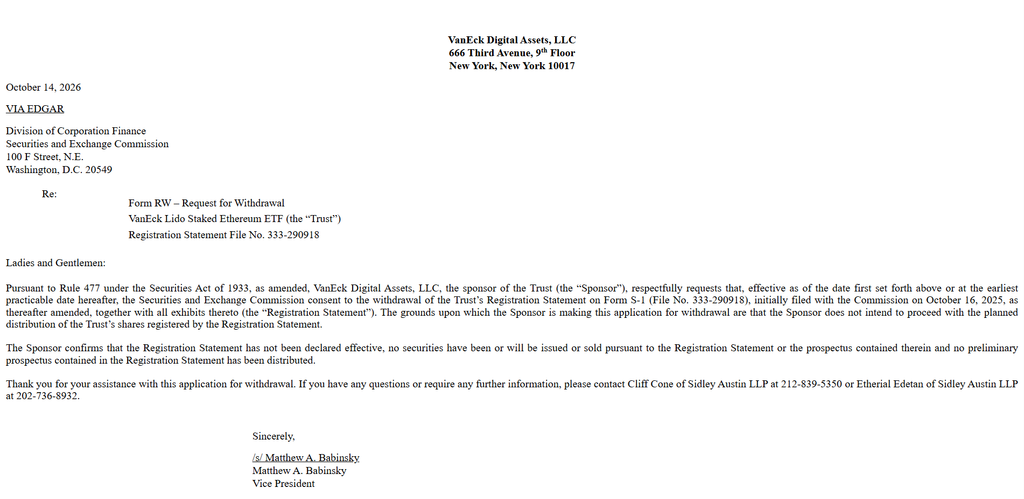
This withdrawal request does not stem from an SEC rejection. VanEck noted that the registration statement was never declared effective, that no securities were issued or sold, and that no preliminary prospectus was circulated. Consequently, the proposed ETF never reached the phase where shares were offered to the public.
How the Proposed ETF Would Have Worked
Initial documentation described a fund intended to follow the price movement of Lido Staked Ether (stETH) minus operating costs. The trust planned to hold stETH directly rather than standard Ether (ETH) or Lido’s LDO governance token.
StETH represents Ether deposited into Lido’s liquid-staking protocol along with its accrued staking rewards. While traditional staking locks up assets during the reward-earning process, liquid-staking provides users with a token that can be traded or utilized while maintaining exposure to the underlying staked assets and accompanying risks. The planned fund would have allowed investors to gain stETH exposure through traditional ETF shares rather than managing the token directly.
The paperwork outlined a passive vehicle that would calculate daily share values using a stETH benchmark rate, noting further that the trust would not utilize leverage or derivatives to achieve its goals. Because the fund never launched, however, investors ultimately missed out on this access vehicle.
VanEck has not offered a public rationale for pulling the application. Furthermore, the filing makes no mention of whether the asset manager intends to roll out a different liquid-staking investment vehicle.
While this specific ETF proposal is now over, the decision leaves the Lido protocol and the stETH holdings of current users completely unaffected. Any subsequent product offerings from VanEck would necessitate a separate announcement and any relevant regulatory paperwork.
Frequently Asked Questions
Did the SEC reject VanEck’s proposed ETF?
No. The withdrawal request was initiated by VanEck itself. The SEC had not declared the registration effective, and no securities were issued or sold.
What was the purpose of the VanEck Lido Staked Ethereum ETF?
The fund was designed to track the price performance of Lido Staked Ether (stETH) after expenses, allowing investors to gain exposure to Ethereum’s liquid-staking market through a traditional exchange-traded product.
Were any shares of the ETF sold to investors?
No, the registration statement never became effective, and no preliminary prospectus or shares were ever distributed or sold.
Why did VanEck withdraw the application?
VanEck did not publicly explain its reasons for withdrawing the application, and the filing did not state whether alternative liquid-staking products are planned.
