


- Coinbase National Trust Company obtained final OCC clearance, with its national trust bank charter taking effect on November 6, 2026.
- This charter enables federally supervised crypto custody and trust operations, excluding retail deposits or conventional banking activities.
Cryptocurrency exchange Coinbase has secured final authorization from the U.S. Office of the Comptroller of the Currency (OCC) to function as a federally chartered national trust bank, broadening its capacity to offer federally regulated digital asset custody.
According to official OCC application filings, Coinbase National Trust Company transitioned from conditional approval to a consummated and effective status on November 6, 2026. The platform originally gained conditional clearance on April 2, 2026, following the submission of its charter application in October 2025.
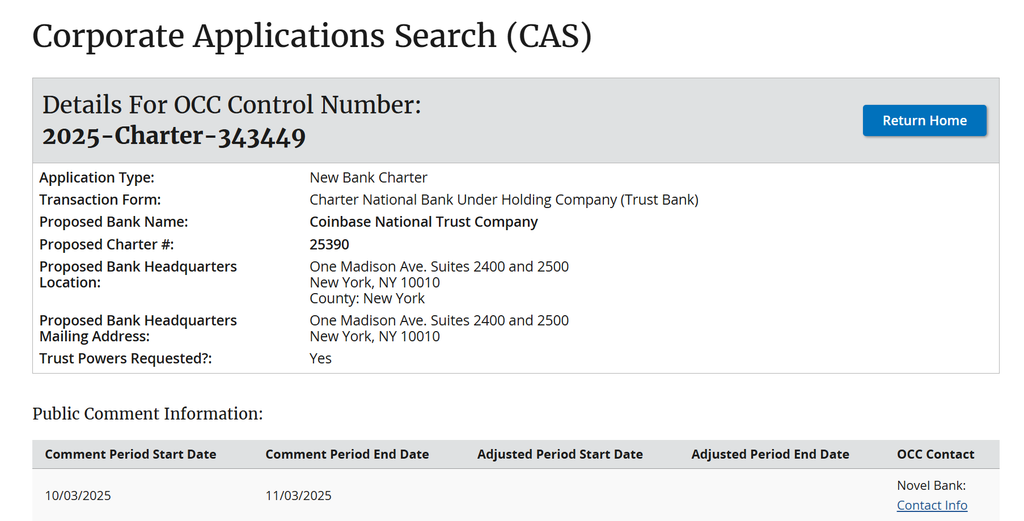
Through this approval, Coinbase establishes a federal regulatory structure for delivering institutional custody and associated trust services. Custody entails securing and maintaining digital assets for clients, specifically targeting financial institutions and large-scale investors.
Ryan VanGrack, Vice Chairman at Coinbase, noted that the authorization brings a larger share of the firm’s operations under federal regulation. He characterized the milestone as an additional advancement in merging digital assets with conventional financial infrastructure.
Coinbase Will Not Operate as a Traditional Commercial Bank
The newly minted charter does not grant Coinbase the ability to function like a standard retail bank. The organization has previously emphasized that it has no plans to take in retail deposits or practice fractional-reserve banking, a method where banks lend out a segment of customer funds.
Furthermore, Coinbase National Trust Company operates as a non-insured national trust company, meaning clients will not be backed by FDIC deposit insurance through this specific entity.
As outlined in its charter application, Coinbase intends to transition its current custody services to the new national trust bank across a three-year span. Additionally, the company will maintain its present state-level regulatory compliances, which include supervision by the New York Department of Financial Services.
This regulatory nod arrives as an increasing number of crypto enterprises pursue federal banking charters to place custody and digital asset offerings under national supervision. Ripple secured its own final OCC national trust bank approval in October 2026, while other entities such as BitGo, Paxos, and Circle have similarly targeted federal trust bank credentials.
This milestone enhances Coinbase’s standing within the institutional crypto custody sector while placing its trust functions under direct federal banking regulation.
Frequently Asked Questions
When did the Coinbase National Trust Company charter become effective?
The national trust bank charter officially took effect on November 6, 2026, following final approval from the OCC.
Does this charter allow Coinbase to offer retail banking services?
No. The charter does not permit Coinbase to accept retail deposits, engage in fractional-reserve banking, or provide traditional commercial banking services.
Are customer deposits insured by the FDIC?
No. Coinbase National Trust Company is structured as a non-insured national trust company, meaning customers do not receive FDIC deposit insurance through the entity.
What will happen to Coinbase’s existing custody operations?
According to its charter application, Coinbase plans to migrate its existing custody operations over to the new national trust bank over a three-year timeframe.
