

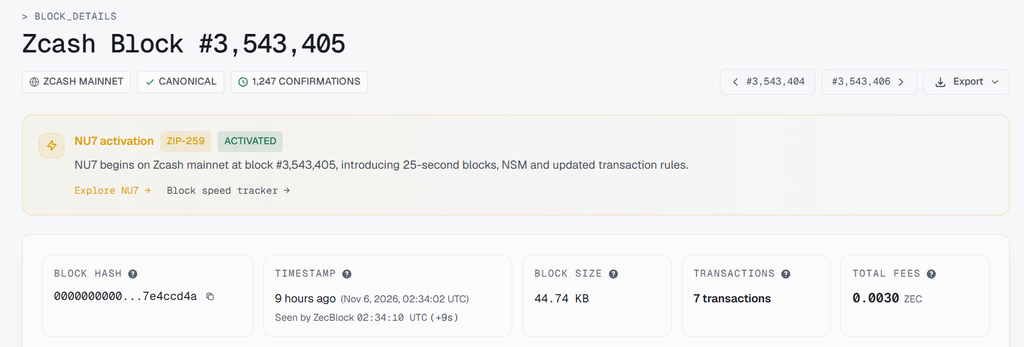
- Zcash activated NU7 at block 3,543,405, cutting its target block interval from 75 seconds down to 25 seconds while boosting potential shielded transaction capacity.
- The network update routes 60% of transaction fees toward a future mining reward reserve and renders roughly 12,224 ZEC within the legacy Sprout pool unspendable.
Zcash has officially rolled out its NU7 network upgrade on the mainnet, bringing accelerated block generation alongside modifications to how transaction fees fund long-term network security.
Blockchain tracking records show the upgrade went live at block height 3,543,405 on November 6 at 02:34 UTC. It shortens the target duration between blocks from 75 seconds to 25 seconds, helping transactions secure their initial confirmation much faster.
This adjustment could render Zcash payments far more viable for everyday transfers, merchant transactions, and exchange deposits. Even so, actual wait times for users will continue to rely on prevailing network conditions as well as specific confirmation thresholds mandated by individual platforms.
In addition, NU7 brings modifications to the platform’s shielded transaction infrastructure, which enables participants to transfer ZEC without publicly exposing the sender, recipient, or transfer value.
NU7 Changes Transaction Fees and Retires Legacy Privacy Pool
A primary adjustment involves the Network Sustainability Mechanism (NSM). Following the new protocol, miners take 40% of transaction fees, while the remaining 60% is directed into a reserve designed to back future mining incentives.
Distributions from this reserve will not occur right away. Scheduled reissuance is projected to kick off around February 2031, specifically at block height 8,939,664. This framework aims to supply a supplementary layer of mining incentives as standard block subsidies decrease over time.
Furthermore, the upgrade decommissions Zcash’s initial Sprout privacy pool, which first launched alongside the network in 2016. Because Version 4 transactions are now classified as invalid, the estimated 12,224 ZEC still residing in Sprout is rendered unspendable via the current protocol, with no approved recovery path currently in place.
At the same time, NU7 places restrictions on shielded transactions per block to minimize the volume of blockchain data that wallets must fetch when scanning for private transfers. These adjustments can lift the throughput for basic Orchard transactions from roughly 2.9 up to 6.6 transactions per second.
Even with the accelerated block pace and updated fee structure, the maximum supply cap for Zcash stays fixed at 21 million ZEC. The upgrade likewise modifies the block subsidy to preserve identical daily token issuance.
Altogether, NU7 represents a substantial shift in Zcash transaction processing and mining economics, with the ecosystem now running entirely on these fresh consensus rules.
Frequently Asked Questions
When did the Zcash NU7 upgrade go live?
The NU7 upgrade activated on the mainnet at block height 3,543,405 on November 6 at 02:34 UTC.
What is the new target block time for Zcash?
The target block interval has been reduced from 75 seconds down to 25 seconds.
What happens to Zcash transaction fees under NU7?
Under the Network Sustainability Mechanism (NSM), miners receive 40% of transaction fees, while the remaining 60% is deposited into a reserve to support future mining rewards starting around February 2031.
What happened to the Sprout privacy pool?
NU7 retires the legacy Sprout pool by making Version 4 transactions invalid, leaving approximately 12,224 ZEC unspendable under the current protocol with no approved recovery mechanism available.
Did the maximum supply of Zcash change?
No, the maximum supply of Zcash remains capped at 21 million ZEC.
