

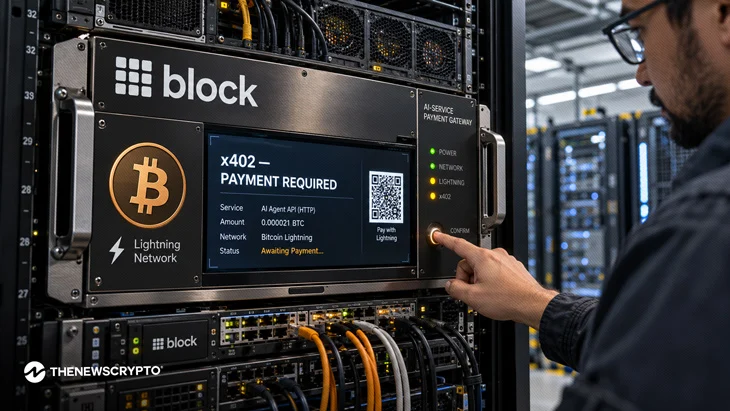
- Jack Dorsey-led Block has become a member of the x402 Foundation, integrating Bitcoin Lightning support into the payment protocol.
- This integration facilitates rapid, affordable transactions between online services—such as APIs and data—and AI agents.
Jack Dorsey’s payments enterprise, Block, has partnered with the x402 Foundation, introducing Bitcoin Lightning Network support to the open payment protocol as part of its ongoing development of transactions between web services and AI agents.
Making the announcement on September 24, Block stated that Lightning is well-suited for the rapid, micro-transactions anticipated in “agentic commerce.” Through this contribution, Bitcoin Lightning becomes an additional payment choice within x402, an open standard enabling web services and software agents to execute payments via standard internet requests.
Block has joined the x402 Foundation, an open standard for agentic payments, to help build the rails that will let people, businesses, and agents pay and get paid.
We’ve also contributed Bitcoin Lightning payments, which is purpose-built for the instant, low-cost, high-volume…
— Block (@blocks) September 24, 2026
Bitcoin Lightning Integrates With x402 Payment Network
The x402 protocol relies on the HTTP 402 “Payment Required” status code to manage transactions. When an AI agent attempts to access a paid digital service, dataset, or API, the service can trigger a payment request. The agent then fulfills the payment and resubmits the request accompanied by proof of completion. Recent data on the x402 website lists 75.41 million transactions and $24.24 million in volume over the past 30 days, though these metrics encompass the entire x402 network rather than being exclusive to Bitcoin or Lightning.
Block’s integration of Lightning targets micro-transactions requiring low fees and high speed. Steve Lee, who leads Block’s Bitcoin development unit Spiral, remarked that adding Lightning to x402 marks progress toward establishing Bitcoin as everyday currency for individuals and their proxy AI agents.
This technical integration is already publicly accessible within the x402 repository. A commit dated September 23 introduced the specification for “exact Lightning on lnbtc.” Nonetheless, the specification remains part of a developing implementation, with reports noting that a Python version still requires further review and live-node testing.
Governance of the x402 standard is managed neutrally by the x402 Foundation under the Linux Foundation. During its operational launch in July, the Linux Foundation reported that the organization counted 40 members drawn from cloud infrastructure, technology, and payment sectors.
Block’s involvement introduces an alternative pathway for settling transactions in Bitcoin on x402, supplementing traditional payment rails and stablecoins. Additionally, Block has pursued other infrastructure initiatives for AI-powered commerce, including its open-source Goose AI agent and involvement in the Universal Commerce Protocol.
At this stage, the update functions mainly as a protocol and infrastructure expansion. While it sets up a framework for Bitcoin Lightning transactions inside x402, widespread utilization by online platforms and AI agents will hinge on developers testing and incorporating the fresh payment alternative.
Frequently Asked Questions
What did Block do regarding the x402 Foundation?
Block joined the x402 Foundation and added Bitcoin Lightning support to the open payment protocol to facilitate transactions for AI agents and online services.
How does the x402 protocol process payments?
It utilizes the HTTP 402 “Payment Required” response. When an AI agent requests a paid API or dataset, the service demands payment, and the agent pays before retrying the request with proof of completion.
Who governs the x402 Foundation?
The x402 Foundation operates under the neutral governance of the Linux Foundation, which had 40 members when it launched operations in July.
Is the Bitcoin Lightning implementation for x402 fully finished?
Not entirely. While the technical work appeared in a September 23 commit for “exact Lightning on lnbtc,” reports indicate that parts like the Python implementation still require real-node testing and review.
