

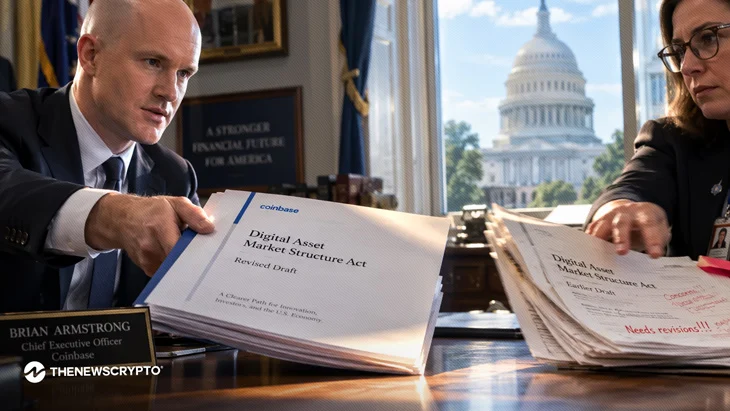
- Brian Armstrong denies responsibility for the Senate’s rejection of the CLARITY Act while anticipating an upcoming report from the Wall Street Journal.
- Armstrong notes that Coinbase rejected the initial January draft but backed the updated version once lawmakers resolved its primary flaws.
Coinbase CEO Brian Armstrong has pushed back against an upcoming article by the Wall Street Journal that he claims will place the blame on him and Coinbase for the CLARITY Act’s failure to move forward in the U.S. Senate.
“Here we go again!” Armstrong shared in an X post. He stated that the WSJ is “working on a story blaming Coinbase and me personally for the CLARITY Act not passing,” while accusing the publication of maintaining a consistently critical stance on the legislation.
Armstrong additionally defended the exchange’s choice to oppose a prior draft of the bill in January, pointing out that the text still contained significant problems concerning stablecoin rewards, tokenization, DeFi, and CFTC authority.
“At the time, the bill had major issues that would have harmed crypto,” Armstrong wrote, adding that industry support was fractured and the measure lacked the backing necessary to pass.
According to Armstrong, Coinbase subsequently collaborated with legislators and stakeholders to modify the bill. He clarified that all four points he initially highlighted in January were ultimately resolved in the draft that passed through the Senate Banking Committee roughly four months later.
“The final draft of CLARITY that went to the Senate was great, and I strongly supported it,” Armstrong wrote.
What Led Coinbase to Oppose the Bill
The disagreement centers on the revisions made to the legislation after Coinbase rejected the January proposal.
In January, Coinbase rescinded its backing for the version slated for a Senate Banking Committee markup. The panel had scheduled a consideration of the bill on January 15, but postponed the markup after Coinbase voiced its grievances.
Armstrong characterized the January text as a “de facto ban on tokenized equities,” expressing worries regarding CFTC spot-market authority, penalties targeting DeFi developers, and restrictions on stablecoin rewards.
The legislation subsequently underwent several months of negotiations involving regulators, senators, and industry organizations.
Senators Angela Alsobrooks and Thom Tillis struck a compromise regarding stablecoin rewards in early May. The updated language banned rewards functionally or economically equivalent to bank-deposit interest while permitting specific rewards tied directly to legitimate platform activity.
Armstrong replied to this compromise with a brief directive: “Mark it up.”
The revised legislation cleared the Senate Banking Committee on May 14 via a 15-9 vote. Coinbase maintained its backing for the measure moving forward, which encompassed provisions regarding anti-money-laundering mandates, consumer protections, self-custody, and the jurisdictions of the SEC and CFTC.
On September 15, the bill failed to advance in the Senate. Senators voted 49-50 against proceeding, missing the 60 votes required for the procedural motion. Armstrong termed the outcome disappointing following the vote, suggesting the CFTC and SEC could still formulate cryptocurrency regulations via their existing powers.
In a separate recent interview, Armstrong mentioned that lawmakers utilized Coinbase’s initial feedback to revise the bill. He argued that the four specific problems were corrected in the newer draft and blamed the legislation’s ultimate defeat on unrelated disagreements.
Armstrong labeled the final result “a missed opportunity for the US to lead.”
His remarks draw attention back to the distinctions between the January text and the iteration that faced the Senate vote. Coinbase resisted the earlier draft but later endorsed the updated version after lawmakers altered the disputed clauses.
Highlighted Crypto News:
a16z-Backed Linera Shuts Down Operations as Funding Runs Dry
Frequently Asked Questions
Why did Coinbase oppose the initial January draft of the CLARITY Act?
Coinbase opposed the January version because it contained significant problems related to DeFi, tokenization, CFTC authority, and stablecoin rewards, which Brian Armstrong described as a “de facto ban on tokenized equities.”
What changed between the January draft and the final Senate bill?
Following months of negotiations between regulators, senators, and industry groups—including a compromise on stablecoin rewards reached in May—all four major areas of concern raised by Coinbase were addressed in the final text.
Did Brian Armstrong support the final version of the CLARITY Act?
Yes. Once lawmakers revised the legislation to address Coinbase’s earlier objections, Armstrong stated that the final draft sent to the Senate was great and that he strongly supported it.
Why did the CLARITY Act ultimately fail in the Senate?
The bill failed to advance on September 15 after a 49-50 Senate vote, falling short of the 60 votes necessary to clear the procedural hurdle due to other disagreements.
