

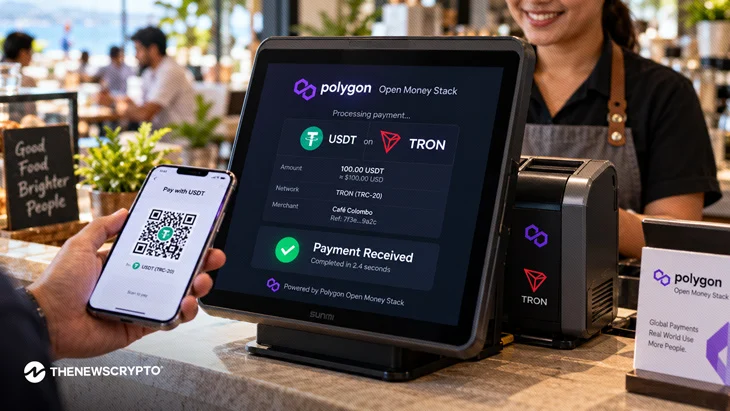
- Polygon Open Money Stack now features TRON support, enabling enterprises to handle USDT deposits, wallets, cross-chain transfers, and payouts through a single integration.
- The TRON network accounts for a circulating USDT supply exceeding $94 billion alongside cumulative transfer volumes surpassing $30 trillion.
Polygon Labs has integrated TRON into its Open Money Stack, empowering commercial entities to construct payment solutions centered on USDT on TRON while linking those transactions to traditional bank accounts, payment cards, physical cash networks, and alternative blockchain protocols.
Revealed on October 8, Polygon’s integration allows organizations to execute an end-to-end stablecoin payment workflow utilizing the Open Money Stack—ranging from initial deposits and digital wallets to cross-chain routing and final payouts. This rollout grants fintech providers, money transfer firms, trading platforms, and payment gateways direct access to the more than $94 billion in circulating USDT hosted on TRON.
Consequently, enterprises can accept funding via bank wires, credit or debit cards, physical cash, or digital assets, subsequently converting fiat currency into TRC-20 standard USDT on TRON. Furthermore, firms can safeguard USDT holdings within custodial or embedded wallets, transfer capital seamlessly between TRON and compatible networks, and disburse payouts to bank accounts, cards, physical pickup centers, or external crypto wallets.
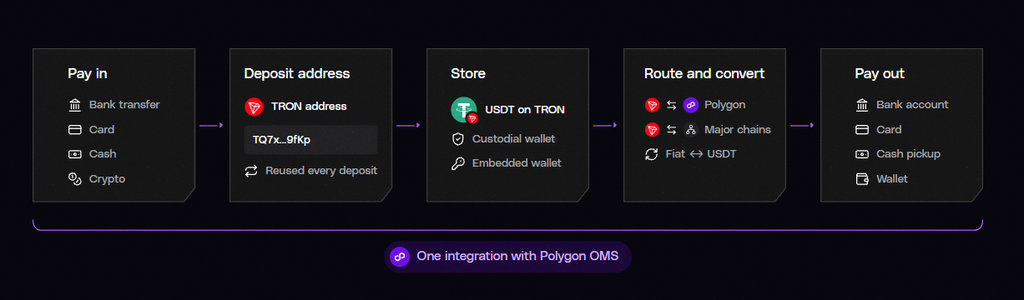
According to Polygon, the update is designed specifically for companies whose client bases already rely on TRON for receiving and sending USDT. Rather than forcing users to migrate capital to an alternative network, organizations can maintain TRON as an active component of their current payment architecture.
TRON USDT Connects With Cross-Chain and Fiat Rails
Additionally, the infrastructure expansion introduces cross-chain routing via Polygon’s framework. Companies can transfer supported assets seamlessly between TRON and EVM-compatible blockchains without necessitating direct customer engagement with standalone cross-chain bridges or third-party wallet services.
When handling deposits, the Open Money Stack generates dedicated TRON addresses for users, accurately reconciling incoming USDT transactions with the proper ledger account. Businesses can subsequently supervise these balances and route capital dynamically to satisfy specific operational workflows.
Simultaneously, Polygon’s existing fiat framework delivers comprehensive on- and off-ramp functionalities. Polygon highlights that its money-transmitter licenses span 48 U.S. states, allowing eligible enterprises to bridge blockchain-derived capital with legacy financial rails.
To date, TRON has logged a cumulative transaction volume exceeding $30 trillion, accompanied by more than 407 million user accounts and 15 billion settled transactions, referencing data sourced by Polygon from TRONSCAN. Additionally, TRON boasts a total value locked surpassing $28 billion.
Polygon noted that the TRON incorporation caters to organizations seeking a unified suite for deposits, digital wallets, cross-chain transfer paths, and payouts, eliminating the necessity to engineer individual components of a payment framework from scratch.
Frequently Asked Questions
What is the Polygon Open Money Stack?
The Polygon Open Money Stack is a toolkit that allows businesses to manage stablecoin payment flows, including deposits, wallets, cross-chain transfers, and payouts.
What new network has been added to the Open Money Stack?
Polygon Labs added support for TRON, allowing businesses to build payment solutions around USDT on TRON.
How does the TRON integration benefit businesses?
It gives fintechs, remittance companies, exchanges, and payment platforms access to over $94 billion in circulating USDT on TRON without requiring their customers to move funds to a different network.
Can businesses connect TRON USDT to traditional fiat rails?
Yes. Using Polygon’s fiat infrastructure and money-transmitter licensing covering 48 U.S. states, businesses can connect blockchain-based funds with traditional payment methods like bank accounts, cards, and cash.
